
Infographic
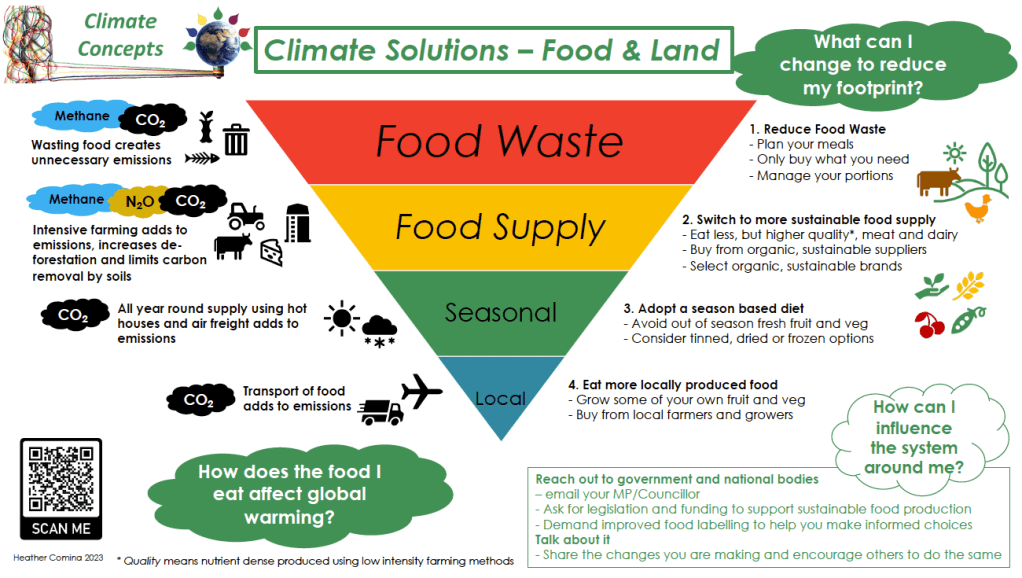
Background Information revised
This Climate Solution has been revised in December 2023 to take into account some new information which includes:
- how the warming potential of different greenhouse gasses is calculated
- the broader impact on ecosystems and biodiversity that different approaches to food production can have
Why is reducing food waste important?
Article on the impact of food waste on Climate Change
How does our diet affect our carbon footprint & why is the way we grow food important?
This is a really complicated question! It depends a lot on where you live in the world and where your main sources of food come from.
A lot of the articles published to date use globally averaged data but, differences in regional farming methods and climates mean that this can be confusing – food grown in Europe is not the same as food grown in America for example. The article below is such an example so depending on where you live, you may have different options when it comes to reducing your impact.
Article on the impact of diet on greenhouse gas emissions
Another challenge is that such articles are, at best, based on the scientific models and data available at that moment in time. As our understanding grows we sometimes need to adjust our thinking and change our behaviours.
One recent example of this is the way the global warming potential (GWP) of different green house gases is calculated. You will see the metric CO2-equivalents used a lot to enable different gases such as CO2, Methane, N2O etc. to be compared on the same chart. The previous method for calculating these values did not take into account the amount of time that certain gases remain in the atmosphere -methane is one such example. The impact of methane on warming is now thought to be lower than previously presented.
Article on new way to calculate Global Warming Potential (GWP*)
When it comes to diet there is no doubt that eating meat as a source of protein has a higher impact than plant based equivalents. This means that we do need to reduce our meat consumption but should we eliminate meat entirely?
Again the answer is complex as meat provides key nutrients which we would need to find from elsewhere in order to remain healthy. There is another important aspect to consider and that is how the meat is produced – there is a huge difference in impact between intensively reared animals and pasture fed , free range, animals. Eating less meat and choosing meat that is more sustainably produced can make a large contribution to reducing our carbon footprint. The more we move away from intensive farming methods the better chance we have of addressing other environmental issue such as biodiversity, water quality etc. as well.
Video on Regenerative Agriculture
Information on Regenerative Agriculture
Information on the benefits of Pasture Fed Meat
Series of articles on Regenerative Agriculture as a solution to Climate Change
Climate Solutions Navigator
Click on the icons below to navigate to more information about each of the Climate Solutions topics.
 Heather Comina