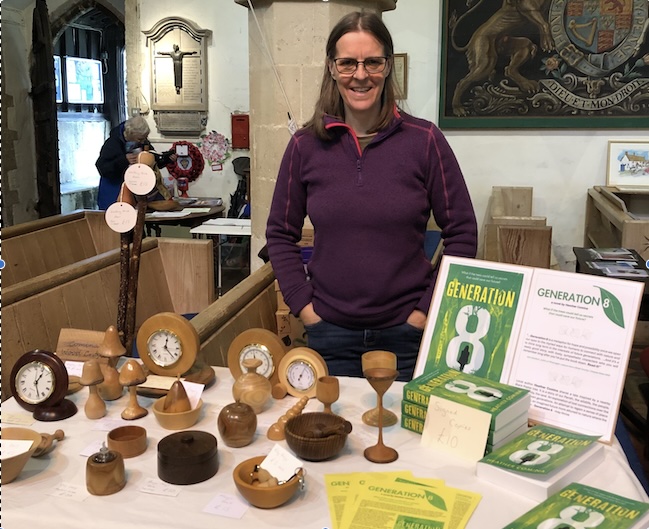
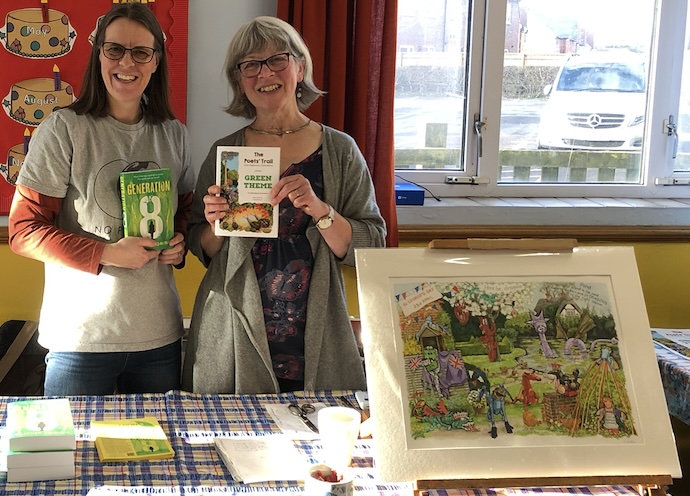
This weekend I had the pleasure of joining local writers, artists and other creative craftspeople to show off our wares and share our thoughts with local residents from the Parish of East Hagbourne and beyond. St. Andrews Church provided a perfect backdrop for an exploration of life in our Parish through the ages. I very much enjoyed the chance to talk about the aspects of the local nature, and community which are embedded within Generation 8. Much tea and cake was consumed and I even sold a few copies of the book and some of my woodcraft too!
To order your discounted copy of Generation 8 just follow the link to the Troubador online shop and use the code REGENER8 at checkout –Happy Reading!
What is the best way to build soil fertility? In my previous post I considered the use of a microbial tea as a soil supplement and described the results of my first Citizen’s Science experiment with broad beans. Here I want to expand on this topic and share my findings from additional experiments with tomatoes and sweetcorn. As before, I determined that the overall goal of my experiment was to understand the impact of the microbial tea on crop yield, plant health and root quality.
In the case of the tomatoes I chose a variety I have had success with in the past (Gardener’s Delight), growing plants in pots in my greenhouse. Seedlings were potted into a 1 to 1 mix of soil and home made compost. Two plants were treated with a root soak solution of microbial tea upon transplanting and two control plants were just soaked with rain water. For the rest of the season the plants were treated identically, feeding occasionally with a solution of fermented kelp.
For the sweetcorn I chose to grow two blocks, of ten plants each, in the same bed separated by a companion row of squash plants. One block of plants was treated with a root soak of microbial tea at transplanting and the other control block of plants was just soaked in rain water. The whole bed had been mulched over winter with straw and treated with a home made compost tea in the spring ahead of planting.
So what were the results like? Was there any visible or measurable difference between plants treated with microbial tea and the control groups? For the tomatoes the plants looked very similar, with healthy leaves, 3-4 fruiting trusses on each plant and a moderate level of fruit set. The yield of tomatoes per plant was slightly higher for the control group compared to the test group (see plot below). In terms of quality of the fruit there was no discernible difference in taste and the BRIX values (see previous post for info on BRIX) were also very similar (6-10% for control; 7-10% for test) and consistent with typical values for cherry tomatoes. The one final thing to consider was the plant roots and whether there were any obvious differences. As you can see from the photo below, the roots looked pretty similar.
Up to now the results were looking consistent with those for the broad beans, described previously, but would the sweetcorn be any different? In some ways, yes. The two blocks of plants looked visually quite different (see photo below) with the test plants being much smaller. It is possible that this may, in part, have been due to this block being closer to a hedge but I have not observed such a dramatic effect on previous crops grown in this bed.
In terms of sweetcorn yield the control group also performed better with a 23% higher yield per plant than the test group (see plot). The corn cobs were generally much larger and better developed (see photo). The corn from the control plants was also tastier with a higher BRIX value (26-30%) than the test corn (23-25%). Overall the yield of sweetcorn was not that impressive. I’ve had better crops in the past when I’ve pre-composted the bed; something I will pay more attention to next year!
The final measure was to look for any difference in the roots of the sweetcorn plants. As you can see from the image below, the roots of the control plant were more extensive than those of the test plant. Interestingly a good portion of the roots in both cases were coated in soil (rhizosheath – see Box 1) which indicates the presence of mycorrhizae.
Box 1 – What can the roots tell you? – Rhizosheaths are coatings of soil particles that cling to plant roots, making roots brown instead of white. They are a sign of biological/microbial activity in the rhizosphere (root zone). Soil particles are bound to the roots by biotic glues, secreted by microorganisms. This is aggregation in action and therefore indicates the formation of good soil structure and healthy plants (note – some species do not form rhizosheaths, such as cultivars in the brassica, allium & asparagus family). To find out more about rhizosheath analysis visit Vidacycle.
I decided to take a closer look at the roots. Using a macro lens on my phone I was able to see a web of filaments around the root which was holding clumps of soil in place but it was not very clear. I turned to the microscope to get a closer a look and what I saw was truly amazing and quite beautiful.
Instead of staining the roots, as is typically done for this kind of analysis (see image in Box 2), I looked at the root filament (soil and all) under natural light conditions (see images below). In both roots from control and test plants I could clearly see mycorrhizal filaments entwined with soil particles. From these examples it appears that the mesh of filaments was more extensive on the control roots but this is highly subjective. What is clear is that both sets of plants had formed mycorrhizal relationships and that the plants did not need to be inoculated with a microbial tea to achieve this.
Box 2 – What is actually in the microbial tea? According to the supplier’s label the tea contained a mix of Endo Mycorrhizae, Trichoderma, Bacilli, Pseudomonas, nitrogen fixing bacteria, humic acids, amino acids, enzymes, yeasts, protein, carbohydrates and seaweed extract. However there were no details on which exact species of mycorrhizae, whether there were spores or auxiliary cells and in what quantities. I had a go at analysing a sample of the microbial tea using my microscope. See the images here for some of my findings. I am no expert on this so I was not able to form a clear opinion on the quality of the sample; my assignments are tentative based on similar images I found online. If you want to dig deeper into this topic then I can highly recommend the University of Kansas INVAM site as they are the real experts.
I think on balance, my results from all three experiments suggest that there was no real benefit from applying the commercial microbial tea to my plants. In the case of the sweetcorn it may even have been detrimental but I can’t be sure. As I said in the first post on this topic, it is useful to consider the advice from Jeff Lowenfells & Wayne Lewis in Teaming with Microbes. Most vegetables, annuals, grasses, shrubs and perennials form symbiotic relationships with Endo Mycorrhizal fungi which provides the plants with a valuable source of nutrients. Growing methods such as tilling (digging) and soil sterilisation disrupt this relationship. So in cases where your soil is recovering from tillage or when you are planting seeds into sterilised potting composts it may be beneficial to inoculate your plants. Otherwise you are probably better off not tilling, leaving the roots of previous crops in the ground and adding good quality home-made composts and mulches to provide everything your plants need – that’s what I will be doing – Happy Growing!
A couple of years ago I decided to make a big change in my stewardship of the soil and plants in our garden. For many years I have grown vegetables with mixed success, and like many growers of my generation, I have utilised artificial fertilisers, herbicides and pesticides alongside more traditional composts. It is only recently that I have discovered the difference between soil and dirt and the harmful effects of artificial inputs on soil life and how this translates to plant health and the nutritional quality of our food – if you are interested in the difference between soil and dirt you might like to read my recent post on this subject – What is the difference between Soil and Dirt?
Taking my first tentative steps on my Regenerative Journey to better growing I implemented a No-dig strategy and was determined to only use composts to feed my plants. At that time I had not learned the art of effective home composting so I had to resort to buying from commercial sources (my compost adventures will be the subject of a whole other post). I supplemented the composts with some home made garden amendments such as fermented nettle and comfrey (again I will discuss these in more detail elsewhere). The results that I achieved were mixed and it was difficult to draw firm conclusions of which composts and/or amendments were most effective. In my enthusiasm to try out new things I had not followed a very structured approach or even kept very good records – it was time to put my scientist hat on and do some Citizens Science experiments!
But where to begin? There are lots of approaches to building soil fertility utilising composts and amendments (as I alluded to above) but what if you don’t have the ingredients you need or the expertise and resources to make them? Can’t you use a commercial product instead? There seem to be a growing number of these popping up online and in garden centres – organic biofertilisers, microbial teas, root inoculants etc. but which ones are right for my garden and how effective are they?
Having done a little online research I opted for a Microbial Tea (from Ecothrive) which looked to be a one stop shop of root inoculant, beneficial microbes and plant nutrients. I was particularly interested in the Endo Mycorrhizae and nitrogen fixing bacteria that were listed in the ingredients; I was not sure if my soil was deficient in these (If you are interested in learning more on the background science of these take a look at Box 1 below). To broaden my experiment I decided to try out this product on crops from different plant families which I routinely grow in my garden so I would have some historical data to compare the results against. I chose Broad Beans, Sweetcorn and Tomatoes – in this post I will share with you the hot off the press results from the Broad Bean experiment.
Box 1
Endo Mycorrhizae
•Mycorrhizae are fungi which form a symbiotic relationship with plant roots. In return for sugar rich exudates from the plant roots, the fungi seek out water and nutrients (such as phosphorous and trace elements) and bring them back to the plant. At least 90% of plants form a Mycorrhizal relationship with one or more fungi.
•There are two types of Mycorrhizae, the first are Ecto Mycorrhizae which associate with Hardwoods and Conifers and the second are Endo Mycorrhizae, sometimes referred to as Arbuscular Mycorrhizae (AM), which associate with vegetables, grasses, shrubs, and perennials (the main exception being Brassicas)
•Mycorrhizal fungi extend the reach and surface area of the plant roots by 100-1000 fold making the plant healthier and more resilient to drought.
•Under natural conditions soil contains all the Mycorrhizae and spores a garden needs but they are fragile and intensive growing practices can easily damage them.
•Leguminous plants such as beans, peas, clovers and vetches form root nodules
•Root nodules are formed by the plant in association with Rhizobia bacteria which fix nitrogen from the atmosphere and transform it into ammonia which the plant can use to generate amino acids, proteins and other essential molecules
•Root nodules which are actively fixing nitrogen are pink to red in colour
I determined that the overall goal of my experiment was to understand the impact of the microbial tea on crop yield, plant health and root quality and, as Broad Beans are legumes, I was particularly interested in seeing if there were any differences in nitrogen fixing root nodules. I designed an experiment in which I would grow two lots of beans under as near as possible equivalent conditions but in one case I would treat the plants at various stages with the microbial tea and in the other case I would just use rainwater as a control. As I wanted a good number of plants to compare I decided to duplicate the experiment in a second plot (for more details of the experiment design see Box 2 below).
Box 2
Protocol
– 30 seeds sown for each lot; control lot soaked pre-soaked in rain water; test lot pre-soaked in Microbial tea solution (1g per litre dilution)
– Seedlings transplanted into 2 plots A and B; 24 control seedlings pre-soaked with rainwater; 22 test seedlings pre-soaked with microbial tea (1g per litre dilution)
– Mature plants treated monthly; 22 mature control plants soaked with rainwater; 20 mature test plants soaked with microbial tea (0.5g per litre dilution)
– Pods from plants in each lot were harvested on the same morning within a one hour window; number of pods, mass of shelled beans and BRIX values recorded
– Roots of plants from each lot were examined and root nodule samples taken for analysis
So what were the results? How much difference, if any, did the microbial tea make? The vagaries of the English spring weather, with unseasonably high rain and relatively modest temperatures, meant that we had a bit of a shaky start – there were so many slugs! All of the plants were damaged and I lost some seedlings but luckily there were enough in each lot to be able to continue. In terms of plant health there seemed to be little difference between the treated and control lots. All of the plants had some degree of aphid attack suggesting that the microbial tea had not had a dramatic effect on plant vitality (healthy plants are more immune to pests).
As we neared the point where the beans were ready to harvest I could hardly hold myself back from picking some pods to get some preliminary data. Visually the number of pods on each plant and their size didn’t look particularly different. As I shelled the pods from each of the lots, taking care to count the pods first, I stood with baited breath over the scales as I weighed each batch. And… as with any experiment of this type the results were not definitive.
As you can see from the plot below, in one case the microbial tea seemed to give a slight boost in both the yield of pods and beans but in the other case there seemed to be no difference at all. Given that both of the beds had received the same regimen of overwinter compost and mulch and had both been used to grow similar crops (beans, and/or beetroot and chard) the previous season there did not seem to be an obvious explanation for the variation in yield.
Plots of number of pods and yield of beans
A further measure of crop vitality is the refractive index of saps or juices, so called BRIX value (see Box 3 for more info on BRIX). For each of the experimental lots a sample of beans were taken and their juice squeezed out and analysed. Again the BRIX values were all broadly similar ranging from 12-16 for the control groups and 10-15 for the treated groups. As BRIX measurements are quite variable I would say there was no significant difference between any of the groups.
Box 3
BRIX – Refractive Index
•Brix (%) is a measure of the light refracting through dissolved solids & sugars with the use of a portable refractometer, and is a useful and quick indication of the health of your plant sample.
•Brix levels fluctuate throughout the day, generally peaking in the afternoon before dropping at night. Brix levels will also vary due to stress or dehydration, so this is a metric you can continue to record regularly throughout the year, to keep a good record of how things are changing.
•The ‘fuzziness’ of the line you read through the refractometer is an indicator of how nutrient dense the sample is – a sharp line can indicate calcium deficiency for example.
•A low brix reading indicates your plant is vulnerable to pest attack and has high nitrate levels (which works against nutrient density & complexity).
What about the roots? The make-up of the microbial tea included root boosting mycorrhizae and nitrogen fixing bacteria so would we see a difference there? The roots of plants from each lot were remarkably similar both in terms of vigour and the number of root nodules – the root nodule density was high in all cases and the nodules themselves were healthy and appeared to be fixing nitrogen effectively (they were all pinkish-red – see picture below).
Sections of root nodules
So on reflection, I would say that, for the broad beans at least, the microbial tea has not made a big difference. Overall the broad bean yield (of all beans combined) was around 12% higher per plant than the previous year much of which can probably be attributed to the improved quality of the home made compost which had been added to the beds. We shall have to see if the story is any different for the Sweetcorn and Tomato experiments which are ongoing.
I think it is worth making a final note on Mycorrhizae based on the sage advice from Jeff Lowenfells & Wayne Lewis in Teaming with Microbes. Most vegetables, annuals, grasses, shrubs and perennials form symbiotic relationships with Endo Mycorrhizal fungi which provides the plants with a valuable source of nutrients. Growing methods such as tilling (digging) and soil sterilisation disrupt this relationship. So in cases where your soil is recovering from tillage or when you are planting seeds into sterilised potting composts it may be beneficial to inoculate your plants. This leaves me to wonder whether my homemade potting compost and No-dig veg plots fed with homemade compost already have all the microbes that my plants need…
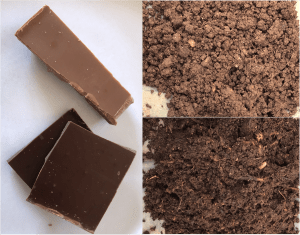
Soil or dirt? Often, we use these words interchangeably but in fact they are very different things. Healthy soil is the deep brown colour of 70% dark chocolate and crumbly; it contains a minimum of 3% organic matter (ideally 20%) and is full of living organisms. By comparison dirt is pale brown in colour, more like milk chocolate and, compacted with large clumps; it is low in organic matter (<3%) with little or no living organisms present.
Comparing chocolate and soil colour – photos by Heather Comina
Healthy soil holds a multitude of living organisms which mostly reside in the top 6 inches (15 cm). Some you can see with the naked eye (earthworms, centipedes, ants, beetles etc.) others can only be revealed under a microscope (nematodes, protists, fungi, bacteria). It is estimated that a teaspoon of healthy soil contains a billion bacteria, tens of metres of fungal threads (hyphae), thousands of protists (amoeba, flagellates, ciliates) and dozens of nematodes.
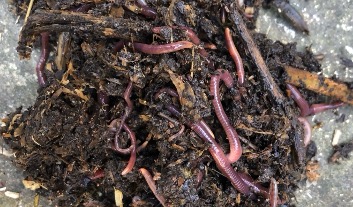
Earthworms – photo by Heather Comina
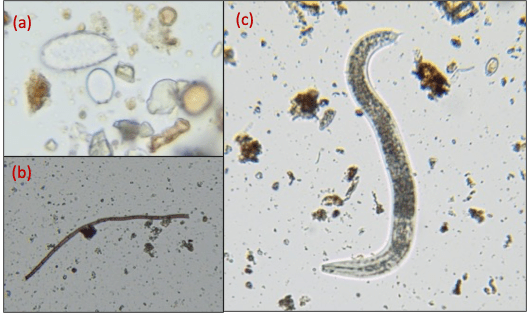
Microscope images of soil organisms – (a) various amoeba; (b) fungal thread; (c) nematode – photos by Heather Comina
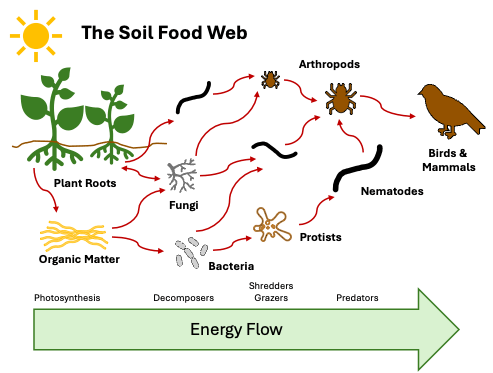
All life needs energy to survive – in the vast majority of cases this energy comes from carbon-based materials supplied by plants, waste products from other organisms or the bodies of dead organisms. Most organisms consume more than one food source creating a complex web of interactions between them. In the context of soil, we call this the soil food web. Each soil environment, with its differing set of soil organisms, produces a different soil food web but, all webs have one thing in common, they always start with the plant.
Plants are at the top of the food pyramid (the first trophic level). They use energy from the sun (via photosynthesis) to generate carbon-based molecules (sugars) from carbon dioxide and water. Some of these sugars are used by the plant but much of them are transferred to the roots where they are secreted as more complex carbon-based molecules such as carbohydrates and proteins (exudates).
Simplified Soil Food Web diagram – created by Heather Comina
These exudates have a purpose – they wake up specific soil bacteria and fungi by providing them with energy to grow and multiply within a zone around each root, a couple of millimetres wide, which is called the rhizosphere. The bacteria and fungi absorb minerals from the surrounding soil which are not directly accessible to the plant. These bacteria and fungi are in turn eaten by other microscopic soil organisms (e.g. nematodes and protists). These higher organisms create waste which is rich in in essential nutrients that the plant needs (e.g. nitrogen, phosphorous, mineral elements including potassium, calcium, iron etc.). These are absorbed from the rhizosphere by the plant roots. So, in a sense the rhizosphere provides an environment where nutrients can be “traded” between organisms for mutual benefit. The key point to note is that the higher organisms (nematodes, protists etc.) are needed in order to release the nutrients “gathered” from the surrounding soil environment by the bacteria and fungi. Without them the system breaks down; the plant needs a fully functioning soil food web to be healthy.
The function of soil food web organisms extends beyond the “trading” of nutrients. They are also important for establishing soil structure – soil that is porous, well aerated, able to soak up and hold water like a sponge. Soil bacteria generate sticky glues and fungi create long thin threads both of which serve to bind soil particles together to form aggregates. Higher organisms such as earth worms, insect larvae and burrowing animals create pathways within the soil of varying sizes serving to mix the soil as well as generate a porous sponge-like structure.
Soil life serves to cycle nutrients through the entire soil food web. When plants and any other soil food web organisms die, they decompose and the nutrients that they contain are recycled, their bodies are consumed by other soil organisms – one organism’s waste is another organism’s food. Without this recycling system essential nutrients would eventually be washed out from the soil.
It is useful to note that if we (as gardeners or growers) apply a chemical fertilizer to the soil only a tiny fraction of it reaches the rhizosphere and is absorbed by the plant. The rest drains through the soil reaching the water table and eventually ending up in rivers and oceans where it has a negative environmental impact. In contrast a functioning soil food web ensures that essential nutrients (many of which are not present in chemical fertilizers) are released within the rhizosphere where and when they are needed by the plant – the addition of external nutrients is not needed!
A healthy soil food web also serves to control disease causing (pathogenic) organisms. Although present in the soil, pathogenic bacteria and fungi are held in check by the vast array of beneficial organisms which outcompete with them for food. Soil health, and consequently plant health, is dependent on the diversity of beneficial organisms which can flourish under a wide variety of conditions. Every part of the soil food web has its place, keeping the other members in balance – it is a self-regulating system. If external forces (such as pesticides and fungicides) start to disrupt this balance then the web no longer functions effectively, nutrient cycling becomes disrupted, and the door is opened to plant diseases.
Whilst it is fairly apparent that some conventional gardening practices (such as the use of pesticides) kill soil food web members at all levels from bacteria up to earth worms and beyond. It is less obvious that using chemical fertilizers is also harmful to the function of the soil food web. Chemically fed plants bypass the microbial assisted method of obtaining nutrients. Microbe numbers fall as the plants stop releasing exudates into the soil; consequently, the higher organisms which feed on the microbes also become depleted. Nutrient cycling within the soil food web starts to fail. Higher organisms such as earth worms, which are irritated by chemical additives, move elsewhere. Waste materials (such as dead plant matter) are no longer broken down, the soil becomes compacted, less aerated and unable to absorb water. Conditions for growing plants become less and less ideal and any interventions such as digging to aerate the soil only serve to make matter worse by breaking up the fragile networks of fungal hyphae – our soil slowly turns to dirt.
However, all is not lost; we have the potential to reverse the decline to dirt and regenerate our soil by making a few simple interventions.
Avoiding further disruption to the soil food web by phasing out the use of toxins such as pesticides, herbicides and NPK fertilisers
Increasing the level of soil organic matter by addition of composts and mulches
Encouraging the return of soil food web members by use of good quality composts (aerobic, balanced, mature), compost extracts and compost teas [beware – many commercial composts are not what you need!]
Maintaining the soil food web by minimal disruption, employing no-dig or minimum till approaches; leaving roots in the ground after harvest; keeping the soil covered all year round with mulches or cover crops
There is much to say on these regenerative approaches; too much to cover here but, fear not, we will cover more on composts and other bio-amendments in a subsequent blog post.
So, why should we care about the health of our soils? Plants grown in dirt are weak and prone to disease; plants grown in healthy soil are lush and rich in nutrients. As, gardeners and growers, we want our plants to be healthy with a minimal need for costly interventions. As consumers we need healthy plants because we are what we eat; we benefit from the nutrients and healthy gut microbiome that we can only get from plants raised in healthy soil.
Art in its many forms be it paintings, poetry, songs or stories, has the power to evoke strong feelings and emotions; providing a link to memories which are often deeper and more sensual than the art itself, a gateway to deeper meaning.
No one will protect what they don’t care about, and no one will care about what they never experienced.
Sir David Attenborough
When we have the chance to be immersed in nature we have the opportunity to capture our experiences, our sense of joy and wonder and transform them into new pictures, poems, stories – stories we can share with others, helping to strengthen their connection with nature, encouraging them to experience it for themselves.
This weekend I had the pleasure of joining local artist Linda Benton and some of the poets from The Poets Trail – Green Theme to share our stories and talk about how our experiences of the natural environment in our local village had inspired us and helped us to feel more connected.
Our friends from the local sustainability group, HUGS, were on hand to share information about local biodiversity projects and stimulate our senses and imaginations with their “What’s in the box?” exhibit featuring a wide range of natural objects. The descriptions we came up with were then transformed into poems by some of the resident poets – a real case of art in action!
Amidst the chatter and copious quantities of tea and cake we took turns to discuss the inspiration behind our work and read short passages. Below is an excerpt of the story I shared with the group about my novel – Generation 8.
In 2020, during lockdown, I had the chance to explore our local area and I challenged myself to learn about the trees I saw. One day I came across and amazing tree; at the time I didn’t know her name. Later I found out that she was a Black Poplar, a relatively rare tree. She was glorious with long straggly branches some of which were interwoven with ivy, others old and dying. Her enormous trunk with characteristic deeply grooved and riven bark, dotted here and there with little holes, homes to many tiny creatures. In her corner of the field she seemed to be standing watch, taking note of all that passed.
I felt connected to her in a way that is hard to explain. It was as if she had something to share, if I only I knew how to ask. I wondered what she might have witnessed in her lifetime of maybe 200 years. What story would she tell? I imagined it would be a story of our Parish, the wildlife, the people, our community, the land. How things had slowly altered over the passage of 7 human generations, steadily becoming less vibrant.
Generation 8 is my attempt to tell this story – an exploration of lost connections over the passage of 7 generations; an attempt to regain a sense of place and belonging; an imagined future more attuned to nature; a future where the next generation – Generation 8 – might thrive.
“There are big days and small days…” (to quote Michael Morpurgo) The big days are often characterised by pushing ourselves out of our comfort zones and doing something completely new.
28th May 2023 will be a big day for me as it marks the publication of my first novel – Generation 8
When I mentioned to some of my friends that I was writing a book about the climate and ecological emergency they assumed that it would be non-fiction. Through my work with Climate Concepts on climate communication, I quickly became aware that people engage best with stories, stories which are relatable to their lives and experiences. I decided that a novel would serve me better.
The narrative around the climate and ecological emergency is typically one of doom and disaster suggesting that it is too late and that we as individuals are powerless to act. Whilst the situation is dire it is not without hope.
The biggest reason that we feel powerless is that we have lost the ability to see how our lives are connected to each other and to the wider community of life. We have little perspective on how our hectic everyday, consumption driven lives are impacting the world around us. The possible paths to a more connected, balanced, thriving future have been talked about for decades but they lie buried in academic literature and policy documents which are inaccessible to many people.
Generation 8 is my attempt to craft a story which I hope will be relatable and have cross generational appeal. A story which provides the reader with a unique perspective on humanity’s almost imperceptibly slow disconnection from the world. A story of hope and possibility exploring how we might learn to re-connect with who we are, where we belong and mend our relationship with mother Earth.
Generation 8 is available in paperback and e-book formats – click on the button below to purchase your copy










 Heather Comina